Complimentary Gartner® Insights
15 Best Practices for Successful Data Migration
In the simplest terms, data migration means moving information. This includes transferring information to a different location, database, or data center, application, environment, or system. Large data volumes, variations in data types, and maintaining the necessary security, encryption, and regulatory requirements increase the complexity of enterprise data migration projects.
Migrating data from legacy software to cloud-based and hybrid systems is complicated. As Gartner explains, “Data migration projects are one of the most challenging undertakings for any organization, irrespective of their size or technical maturity.”
In this research, Gartner outlines the best practices for data migrations, categorized into four phases: planning, design, development, and delivery.
Migration of legacy email and files to Cloudlocker while implementing the best practices for data migration outlined by Gartner can result in a successful migration. Cloudlocker’s simple platform works with each phase Gartner explores: planning, design, development, and delivery.
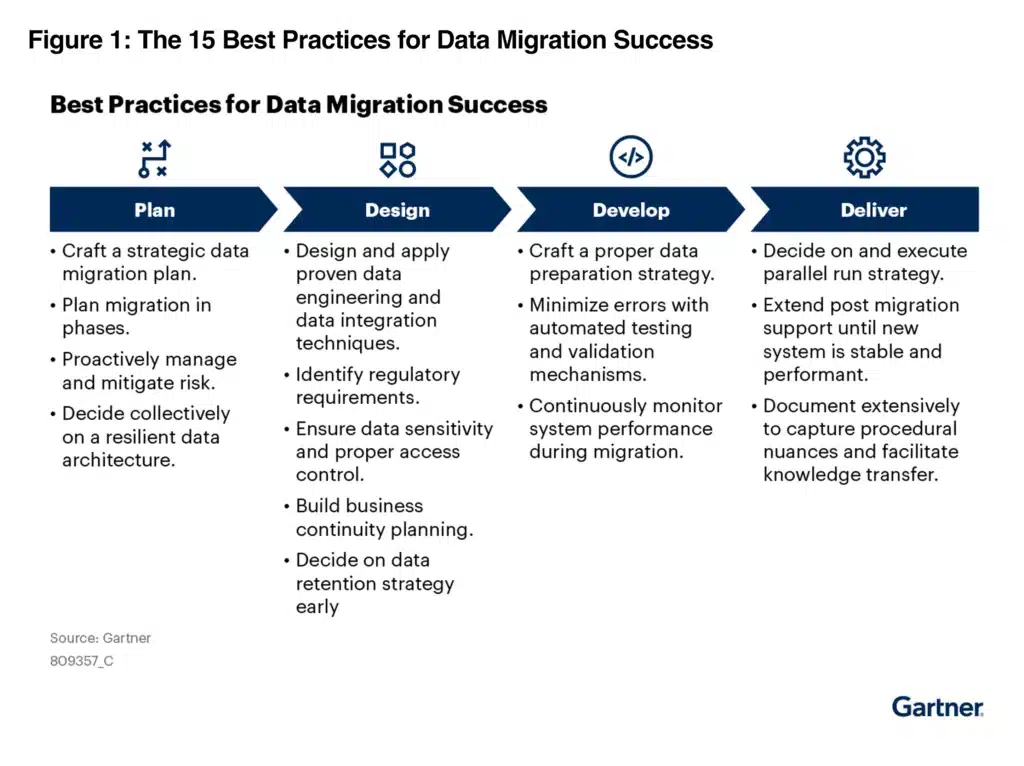
Gartner, 15 Best Practices for Successful Data Migration, By Masud Miraz, Henry Cook, Melody Chien, 7 April 2025
Gartner is a trademark of Gartner, Inc. and/or its affiliates. This graphic was published by Gartner, Inc. as part of a larger research document and should be evaluated in the context of the entire document. The Gartner document is available upon request from Cloudlocker.